
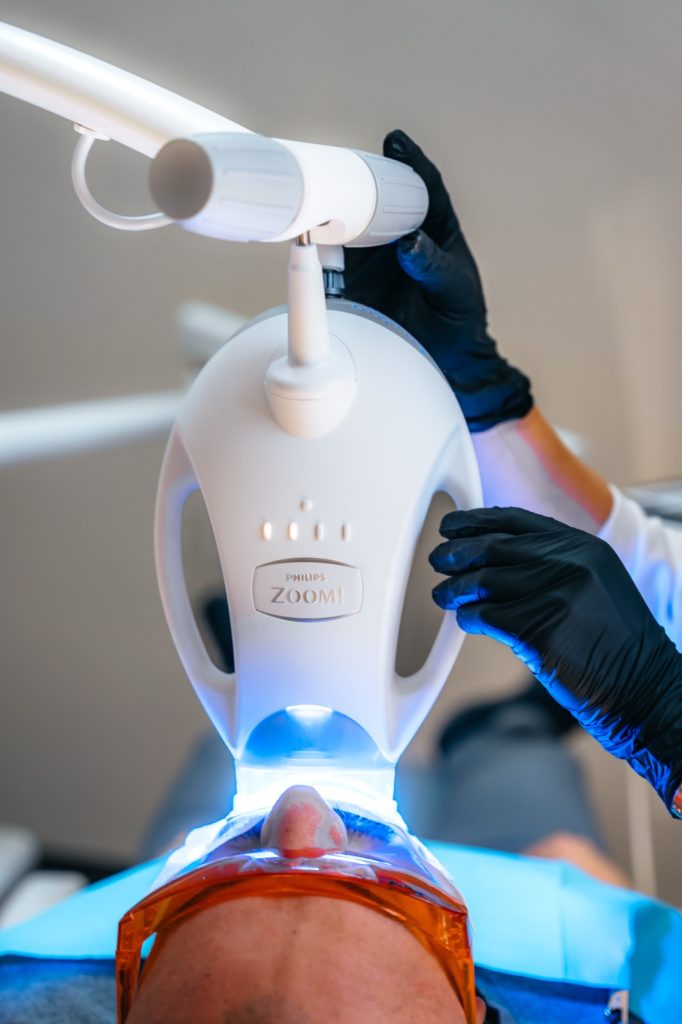
The dentist who whitens your teeth did it to her own, and tells you what that actually felt like
This is the original Glisten chair. Dr. Revan Dawood, DMD, started the practice here on Pecos Road in Gilbert, and one thing she will tell you about whitening that almost no cosmetic page will is what it felt like when she did it on herself, at full strength:
“I did whitening at the highest concentration on myself, and my teeth were sensitive for 3 days, brutally sensitive. But the results were so good, I did it again and again year after year.”
That is the honest center of this page. Whitening works, it’s worth doing, and it can make your teeth sensitive for a few days if you push the concentration. She knows because she’s lived it, more than once. She’s not going to tell you it’s nothing. She’s going to tell you the truth and then manage it so you’d do it again too.
The three real options, ranked the way she actually ranks them
Most whitening pages list “options” as if they’re equal. They are not. Here is how Dr. Dawood lays it out, in her words:
“In-office Zoom is the fastest and the strongest with results showing after 2 hours, great for events or people who just don’t want to do the work at home everyday for 2 weeks. Take-home trays are also an option. The whitening is more gradual, less sensitivity, and the results are just as good over a few weeks. But it takes the patient’s commitment and compliance to stick with it. Most patients don’t want to deal with that. OTC strips? Honestly fine for maintenance or very mild discoloration but you’ll never get the brightest whitest you’ll ever be with those. If your teeth are already pretty white and you just want to touch up, strips aren’t a waste of money.”
Read against the grain of how this is usually sold, that’s a decision tree, not a menu:
In-office Zoom: fastest and strongest. Results in about two hours, in one visit. This is the one if you have an event, or you simply will not do trays every night for two weeks. It is also the strongest, and the trade-off for that strength is the sensitivity she described above, which we manage deliberately (below).
Custom take-home trays: gradual, less sensitivity, same end result. Just as white over a few weeks, with noticeably less sensitivity along the way. The honest catch, in her words: it only works if you actually wear them. “Most patients don’t want to deal with that.” If you know yourself well enough to know you’ll stick with it, this is a genuinely excellent path.
Drugstore strips: fine for one specific job. Not a rip-off, not the answer to real discoloration. If your teeth are already fairly white and you want a touch-up, strips do that job. If you want the whitest you’ll ever be, they won’t get you there, and she’d rather say that than sell you something stronger.
The sensitivity protocol, because she’s not going to pretend it doesn’t exist
She already told you her own teeth were sensitive for three days. So here is exactly what the practice does about it, verbatim:
“We use a desensitizing gel before and after, and we don’t push people to whiten more aggressively than their teeth can handle. If sensitivity is a history for someone, we start slower or with a lower concentration.”
That is the whole protocol and it is honest in both directions. Desensitizing gel before and after, every time. The strength is matched to your teeth, not to a one-size setting. If you’ve had sensitive teeth before, you say so and we start lower or slower on purpose. You do not have to find out the hard way. This is the established practice; there is no rush-it-through pressure here.
How long it lasts, and how to keep it without re-treating
In-office whitening is not permanent, and she’ll tell you exactly what erases it:
“In-office results typically hold well for 6–12 months before any noticeable drift, depending on diet and habits. Coffee, red wine, turmeric, and smoking are the biggest culprits. Touch-up trays every few months make a big difference in extending it.”
Six to twelve months before any noticeable drift, then touch-up trays a few times a year keep it bright. Coffee, red wine, turmeric, and smoking are the fastest way to lose it. This is also why the in-office price includes a take-home touch-up kit. See cost, below.
When whitening is not the honest answer: tetracycline staining
The hardest conversation in whitening, and the one the founding practice has early on purpose rather than after you’ve paid:
“Tetracycline staining is one of the hardest things to treat with whitening alone. I tell them the truth: whitening barely improves it, and it may not get where they’re hoping. Tetracycline staining is staining embedded into the pores of our teeth from inside out. This cannot be removed, but it can be covered. Veneers often end up being the more realistic path to the result they actually want. I’d rather have that conversation early.”
If your staining is from tetracycline, the deep, banded, gray-brown kind from the antibiotic, whitening barely moves it. That is not a sales pitch for something more expensive. It is the opposite: she would rather tell you up front that whitening won’t get you there than take your money for a result it can’t deliver. If covering it is the goal, veneers are the realistic path, and she’ll explain that honestly before you spend anything on whitening that won’t work.
What it costs, the way Dr. Dawood actually does cost
There is no surprise number here. The canonical, current pricing:
- In-office Zoom whitening: $400–$600. This includes the treatment **plus a
take-home touch-up kit**, the same kit that keeps the result going for the 6–12 months she described above.
- Custom take-home trays: $200–$350. Custom-fitted to your teeth.
And cost is handled the way she handles every number, not the way a rate card does:
“I always walk through it line by line with them. I never just hand someone a number and walk away. We pull up their insurance benefits together, I show them exactly what’s covered, what’s not, and what their out-of-pocket looks like before we ever schedule anything. No surprises.”
Whitening is cosmetic, so most dental insurance does not cover it, and we’ll tell you that plainly rather than let you find out on a statement. The new-patient exam is currently $89; that’s a separate standing offer, not the whitening price. If the honest answer for you is “strips will do the job you actually want,” you’ll hear that too.
Talk to the founding Glisten practice
If you want a whiter smile, the most useful first step is the visit where Dr. Dawood tells you honestly which method fits your teeth and your life, and whether whitening is even the right tool for the staining you have. Sometimes it’s “in-office, here’s what to expect.” Sometimes it’s “trays, if you’ll wear them.” Sometimes it’s “this won’t get you where you want. Here’s what will.” You’ll know before you spend anything.
Glisten Dental Studio: 4365 E Pecos Rd, Ste 127, Gilbert, AZ 85295 Call 480-331-4955 or book a visit through our contact page.
Why patients choose Glisten
All your dental work, in one place
Our small team of multi-specialty dentists handles implants, restorative, cosmetic, and orthodontics, so you're not being passed between three different offices to finish your work.
We advocate with your insurance
We file claims directly and follow up with your insurance company on your behalf to help cover what they should, instead of leaving the paperwork to you.
Honest, no-pressure plans
We recommend only what's actually necessary. Your treatment plan is written so you can take it anywhere for a second opinion, no hard sell, no over-diagnosis.