
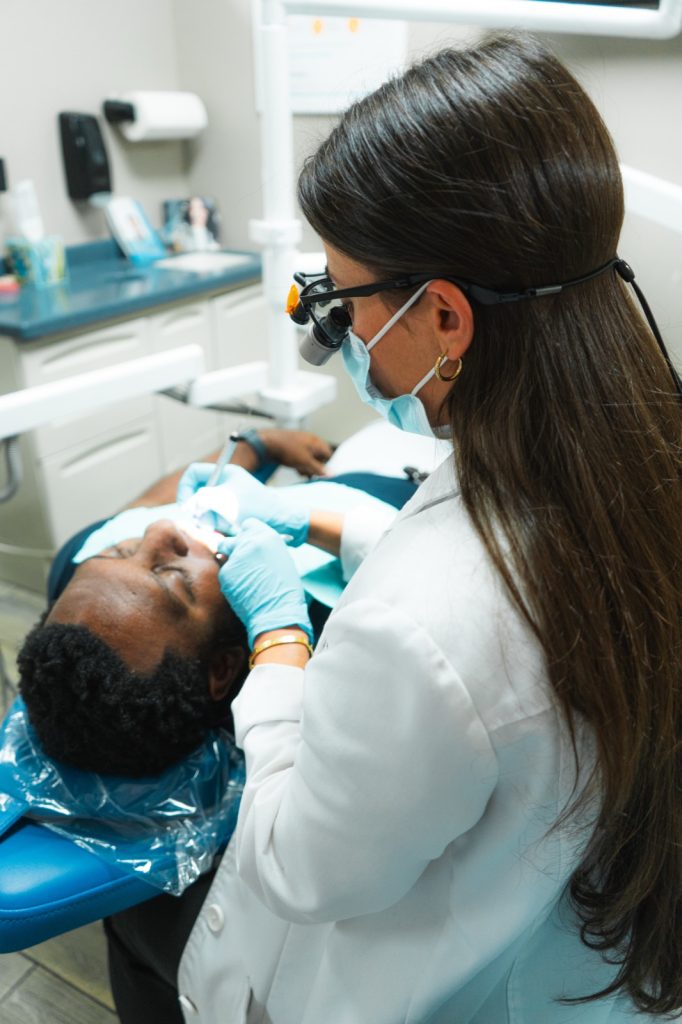
One tooth, replaced for good: explained the way Dr. Dawood actually explains it
Most people who land on this page have one missing or failing tooth and a short list of worries: whether it will hurt, what it really costs, and whether they are even a candidate. Glisten Dental Studio on Pecos Road is where this practice began. Dr. Revan Dawood, DMD, founded it here, and Gilbert has the longest-running patient base of the three offices. This page answers those three worries in her words, because the way she talks a nervous patient through an implant is the reason a lot of people drive past closer offices to sit in this chair.
No pressure. Plain answers. Where her own words say it better than anything we could write, we left her words alone.
Call 480-331-4955 to book a consultation, or use the contact page.
What a single dental implant actually is
A single implant replaces one missing tooth, root and all, with a three-part assembly that functions like the tooth you lost:
- The fixture: a small medical-grade titanium screw placed where the natural root used to be. The bone heals around it and fuses to it over about three months.
- The abutment: the connector that screws into the fixture and comes through the gumline.
- The crown: the visible tooth, made from lithium disilicate or full-contour zirconia depending on which tooth it is and how it has to look.
You brush and floss it like a real tooth. It will not get a cavity, because titanium and ceramic do not decay. The one thing it can still develop is gum disease around it if it is not cleaned, which is why maintenance is part of the plan, not an afterthought.
When a single implant is the right call, and when it honestly isn’t
This is the part Dr. Dawood does not skip, and most offices do, because the more expensive answer is better for the office and not always better for you. A single implant is the most predictable long-term fix for one missing tooth: it does not grind down the healthy teeth on either side the way a bridge does, and it keeps the jawbone from shrinking where the tooth left.
But it is not the only honest option, so here are the real alternatives with their real numbers, side by side, not to steer you to the priciest one:
- Single implant (fixture + abutment + crown, all included): from $2,900 at Glisten. Best long-term predictability; does not touch the neighboring teeth.
- Bridge: roughly $2,500–$4,000, usually 3–4 weeks, but it requires shaving down the two teeth beside the gap, and it typically lasts 10–15 years.
- Partial denture: roughly $1,200–$2,800, removable, the least stable for chewing and the lowest cost up front.
If a bridge or a partial is genuinely the right call for your mouth and your budget, that is what you will hear. The number above is Glisten’s own price for the implant itself; the bridge and denture figures are the going range for those alternatives so the decision sits in honest context instead of floating alone.
If your decision is really between fixed teeth and removable teeth, this may help: dental implants vs dentures. It lays out when dentures are honestly the right call, too.
The single-implant journey at Glisten, step by step
Most timelines online are brochure ranges. Here is the actual sequence this practice runs, in Dr. Dawood’s words:
“Consult and imaging day one. At Glisten Dental, we specialize in implant placement on the same day as tooth extraction. This means the patient only goes through one surgery, not two. Once the implant is placed, the bone has to heal around the implant and fuse to the implant. That takes about 3 months for bone to remodel and heal. Then after 3 months we see the patient back to take measurements for a crown. We order the crown and 2 weeks later the final crown is placed. Start to finish, straightforward cases run about 4 months. We give every patient their specific timeline at the consult, not a range off a brochure.”
The detail worth holding onto: if the failing tooth still has to come out, placing the implant the same day means one surgery instead of two. About three months for the bone to fuse. Measurements after that, final crown roughly two weeks later. Straightforward cases, start to finish, about four months. Your case may run differently, which is exactly why you get your own timeline at the consult instead of a number copied off a website.
Bone grafting and sinus lifts: when an extra step is needed
If a tooth has been missing for a while, the bone where it used to be may have narrowed, and the implant needs a solid foundation. Sometimes that means a small graft at the time of extraction (a socket-preservation graft, roughly $250–$450 per site) to keep the ridge from collapsing in the first six months. Upper back teeth sometimes need a sinus lift before placement. These are not upsells; they are the difference between an implant that holds and one that does not, and Dr. Dawood will tell you plainly whether your case needs one and why.
Materials, lifespan, and what keeps an implant working
The fixture is medical-grade titanium. The abutment is titanium for back teeth where strength matters most, zirconia for front teeth where color matters more. The crown is lithium disilicate or full-contour zirconia depending on the tooth.
Implants have a 95%+ ten-year survival rate in healthy non-smokers and 90%+ at twenty years. The single largest predictor of failure is smoking. Failure rates run two to three times higher in smokers, which is why she asks patients to stop four weeks before surgery and eight weeks after, at a minimum. The implant itself generally integrates permanently; the crown on top may need replacing once over its life. Day-to-day, it is brushing, flossing, and regular visits, the same maintenance as a natural tooth.
If you already have an implant that’s giving you trouble, here is what that can mean and what to do next: failing or painful dental implant.
What to look for in an implant dentist, anywhere
This holds whether you choose Glisten or not. A 3D cone-beam scan on every case, not selectively. A planned, guided placement rather than freehand. The diagnosis, surgery, and final crown handled by the same group rather than farmed out across three offices. Someone who has done enough of these to make that judgment routine. And a clear answer on what the number includes before you commit to it.
What it costs here, and why we will not hand you a number and walk away
A complete single implant at Glisten Dental Studio, the fixture, the abutment, and the crown, all included, is from $2,900. That is the actual treatment, not a deposit and not a teaser that grows once you are in the chair. Whether a particular case lands above that depends on whether extraction or a graft is part of your specific plan, and you will see that in writing before anything is scheduled.
The number is not the part that matters most, though. This is:
“I always walk through it line by line with them. I never just hand someone a number and walk away. We pull up their insurance benefits together, I show them exactly what’s covered, what’s not, and what their out-of-pocket looks like before we ever schedule anything. No surprises. If the treatment cost feels out of reach, we figure out a way together. We have financing options also.”
You get a written, line-by-line estimate before treatment, every time, with your insurance benefits open on the screen. We are in-network with most major dental PPOs, and there is a free in-house specialist who helps patients sort through Medicare Advantage dental options. If something changes mid-procedure, we stop and talk to you before we keep going. That is the standard this practice was built on, in the chair where it started. The $89 new-patient exam is a separate standing offer and is not the implant price.
The full cost breakdown, in one place
If you want the whole money conversation in one place, what the single implant number includes, what can change the estimate, how insurance usually behaves, and how Cherry financing fits in, read the full dental implant cost breakdown for Gilbert.
That page also separates the single-tooth conversation from the full-arch conversation, because those numbers should not be mixed. A complete single implant starts from $2,900. All-on-4 is $15,999–$23,999 per arch. Those are different treatments, and they should be explained that way.
The consult is where the estimate becomes specific. If extraction, a graft, or another step is needed, you will see it as its own line, not buried inside a number nobody explained. That is the only way the decision stays honest.
What about All-on-4?
All-on-4 is a different conversation from one missing tooth. It is for people missing most or all teeth in an upper or lower arch who want a fixed full-arch option instead of a removable denture. At Glisten, All-on-4 is $15,999–$23,999 per arch. Per arch means upper or lower, not both arches.
If that is the decision you are facing, start with the All-on-4 treatment page, then compare the trade-offs here: All-on-4 vs traditional implants.
The most important thing is not whether the treatment has a familiar name. It is whether the plan fits the arch, the bone, the bite, the medical history, and the way you actually want to live with your teeth afterward. Sometimes fixed full-arch teeth are the right answer. Sometimes a staged plan is smarter. Sometimes a denture is the more honest first step.
How the consultation is supposed to feel
A good implant consultation should make the decision clearer, not heavier. You should leave knowing whether you are a candidate, what the scan showed, what the likely timeline is, what the treatment includes, and what the estimate means. If the answer is no, or not yet, you should understand that too. That is part of the care, not a detour from it.
That is the tone of this office because implant dentistry has enough pressure around it already. People come in worried about pain, cost, and being judged for waiting. The job is to slow the decision down enough that it becomes manageable.
“Am I a candidate?”: exactly how that gets decided
A lot of people have been told somewhere that they can’t have an implant and walked away believing it without ever being properly evaluated. Here is the order Dr. Dawood actually works through, in her words:
“First I study their bone by taking a cone beam radiograph. I want to make sure we have enough bone to work with. Then gum health: any active infection has to be treated first. I do a complete medical history review and see if there are any contraindications for implants considering the patient’s current health and medications. Smoking matters because it significantly affects healing. Medical history concerns include uncontrolled diabetes, blood thinners, certain medications, all factor in. Age is almost never a disqualifier as long as the jaw is fully developed. Most people are candidates, they just don’t know it yet.”
Sit with the last line. “Most people are candidates, they just don’t know it yet.” Age by itself almost never takes you out of the running. A scan, a look at your gum health, and an honest read of your medical history and medications is what decides it, not a glance and a guess.
“Is it going to hurt?”: the real answer
This is the question that keeps people from even calling, every single time. So here it is on the page. Her explanation, unedited:
“That it’s going to hurt terribly [is the biggest misconception]. Most patients are shocked by how manageable recovery actually is. The anticipation is almost always worse than the reality. Bone does not actually have nerves in it to feel pain. The little pain that is associated with implants is actually the gums healing, just like if someone took a bite out of a hot piece of pizza and burned the roof of their mouth. After a few days that sensation goes away. Same with implants.”
Bone itself does not feel pain. What you feel afterward is gum tissue healing, like the roof of your mouth after hot pizza, and it settles within a few days. On top of that, the practice rule holds for the surgical visit the same as every visit: nothing starts until you are completely numb and comfortable, and the numbness is tested first so it is not a guess. If you feel something, we stop.
Why people choose the Gilbert practice for this
Gilbert is the original Glisten location and has the longest-running patient base of the three. Dr. Revan Dawood, DMD, founded the practice here on Pecos Road; Dr. Joshua Baer works across all three offices. The scan, the surgery, and the final crown are handled by the same small group of dentists who do these regularly, not split across a surgical center and a separate restorative office. The reason most people give for switching to Glisten is short: over-diagnosis somewhere else, a price nobody explained, treatment built around the practice instead of the patient, or simply not feeling like anyone cared. A single-implant decision is exactly where those things cost you.
Call 480-331-4955 to book a consultation, or use the contact page. Glisten Dental Studio, 4365 E Pecos Rd, Ste 127, Gilbert, AZ 85295.
Dental Implants in Nearby Communities
Patients drive to our Gilbert office for implant care from across the East Valley. If you are closer to one of these communities, start here:
Why patients choose Glisten
All your dental work, in one place
Our small team of multi-specialty dentists handles implants, restorative, cosmetic, and orthodontics, so you're not being passed between three different offices to finish your work.
We advocate with your insurance
We file claims directly and follow up with your insurance company on your behalf to help cover what they should, instead of leaving the paperwork to you.
Honest, no-pressure plans
We recommend only what's actually necessary. Your treatment plan is written so you can take it anywhere for a second opinion, no hard sell, no over-diagnosis.